Keep your workplace safe and compliant with our range of spill kits and absorbents — oil & hydrocarbon and general-purpose kits in 120 L and 240 L, plus socks, pads and booms.
120 L and 240 L options.
For a wide range of liquids.
Socks, pads and booms.
Meet workplace safety requirements.

| Product |
|---|
| 120 L Oil & Hydrocarbon Spill Kit |
| 240 L Oil & Hydrocarbon Spill Kit |
| 240 L General Purpose Spill Kit |
| Absorbent socks, pads & booms |
Stay safe and compliant with Liquidia's range of spill kits and absorbents. Our oil & hydrocarbon and general-purpose spill kits (120 L and 240 L) are ready-to-deploy for rapid spill response, and we supply absorbent socks, pads and booms plus bunding to contain and clean up spills across workshops, depots, transport yards and worksites.
Choosing the right spill kit helps you meet workplace safety and environmental requirements. Talk to us about the right spill kit and absorbents for the liquids you handle, with supply Australia-wide.
The first question is not size, it is what could leak. Absorbents are made to pick up different kinds of liquid, and the wrong one can sit on a spill and do very little.
Oil-only absorbents pick up oil, diesel and hydraulic fluid but repel water. That makes them the right choice outdoors, in wash bays or anywhere rain is involved, because they soak up the oil and leave the water behind.
These absorb water-based and oil-based liquids alike: AdBlue®, coolant, demineralised water, oils and most mild workshop fluids. They suit mixed workshops and depots where you do not know what the next spill will be.
Chemical absorbents are made for acids, caustics and other aggressive liquids that could attack standard absorbents. If you store other liquids on site, check their SDS and ask us before relying on a general purpose kit.
AdBlue® is mostly water, so an oil-only kit will not absorb it. It is low hazard, but it should not be washed into stormwater drains, and it leaves white urea crystals and a slippery surface as it dries. Keep a general purpose kit next to your AdBlue® IBC, drum or bulk tank, and see our guide to AdBlue® spill kits for the clean-up steps.
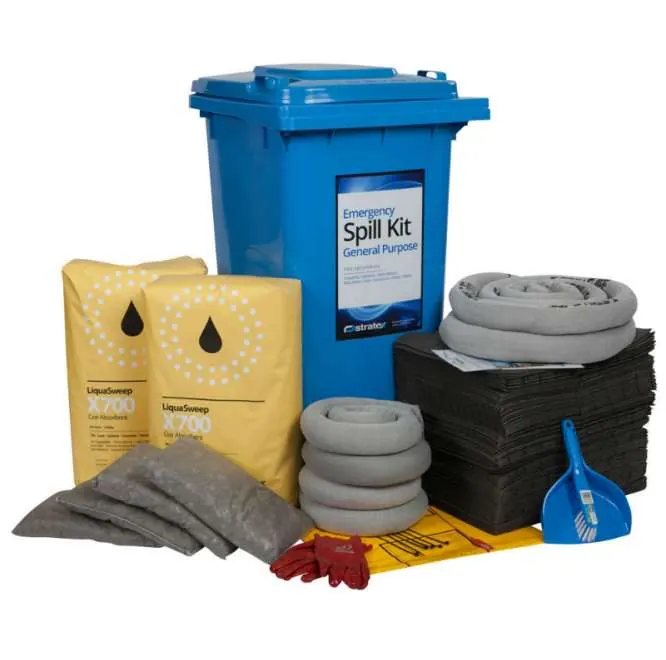
Spill kits are rated by roughly how many litres their contents can absorb. A common starting point is to size the kit so it can handle the largest single container that could fail in that area.
| What is stored nearby | Suggested starting point |
|---|---|
| Bottles, 10 L to 20 L packs, small workshop leaks | 120 L kit, plus pads for daily drips |
| A 200 L or 210 L drum, or a pallet of 20 L packs | 240 L kit |
| 1,000 L IBCs | 240 L kit plus socks or booms to contain the spread, and bunding under the IBC |
| Bulk tanks from 5,000 L | A bunded tank, one or more kits at the fill and dispense points, and drain protection |
A kit will not hold back a full IBC or tank failure on its own. For larger volumes, the bund does the containing and the kit handles the drips, hose failures and overfills. Our bunding and storage guide explains the difference.
In general terms, workplace health and safety laws expect businesses that store liquids and chemicals to manage spill risks, and environmental regulators treat pollution of stormwater and waterways seriously. Rules differ between states, so check the requirements that apply to your site.
This is general guidance only. Your state environment protection authority and WHS regulator set the rules that apply to your site.
No. Oil-only absorbents repel water, and AdBlue is mostly water. Use a general purpose kit near AdBlue storage and dispensing points.
A common starting point is a kit that can absorb the largest single container that could fail in that area. For example, a 240 L kit near 200 L or 210 L drums. For IBCs and bulk tanks, rely on bunding to contain a major failure and use kits for drips and overfills.
No. Keep spills out of stormwater. Absorb it with a general purpose kit, then rinse the area lightly and collect the rinse water where possible.
It depends on what they absorbed. Bag and label them, and dispose of them through a waste contractor licensed for that type of waste. Oil-soaked absorbent should not go in general rubbish.
Tell us your volumes and we'll sort out a competitive quote.