Open Hours: Mon–Fri 7:30–16:00Get a bulk quote →
Batch lookup

Check the certificate for your batch

Enter the batch number from your drum or IBC label and see the lab results for the exact AdBlue® you bought.

Find your batch

The batch number is printed on the label of every Liquidia drum and IBC.

Try SAMPLE to see what a certificate looks like.

Why we do this
  • Every batch is lab-tested to ISO 22241 before release
  • You can check the result for the exact AdBlue® in your tank
  • Copies are watermarked to stop them being passed off by others
Reading a certificate

The four numbers to check

A certificate lists about 20 results. These four tell you most of what you need to know. They are numbered and highlighted on the example certificate.
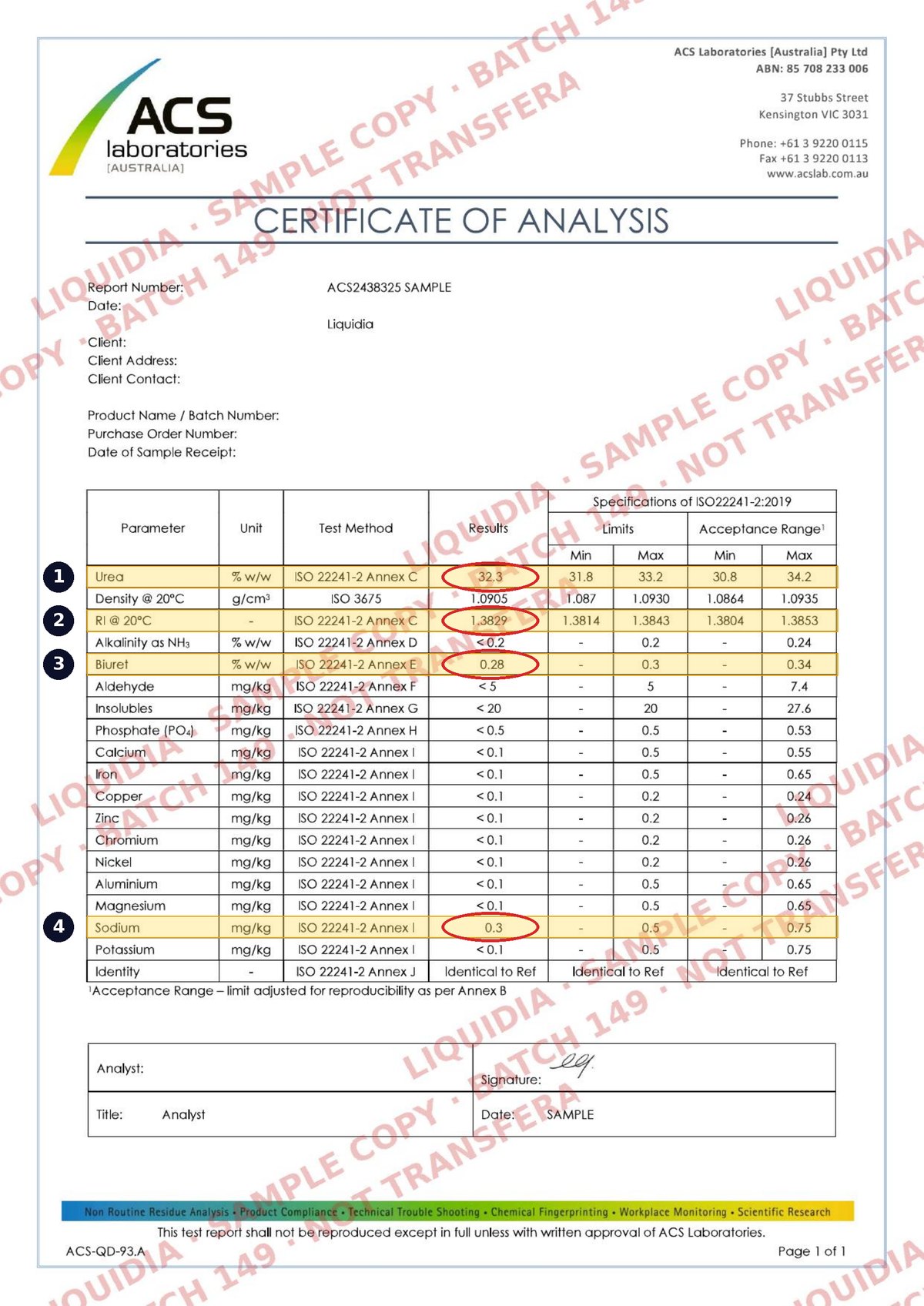
Example AdBlue certificate of analysis with urea, refractive index, biuret and sodium highlightedTap to enlarge
  1. 1
    Urea contentLimit: 31.8 – 33.2 % · Example: 32.3 % ✓

    The strength of the solution. SCR systems dose as if it is 32.5 %.

  2. 2
    Refractive index at 20 °CLimit: 1.3814 – 1.3843 · Example: 1.3829 ✓

    A second strength check, and the one you can do on site with a refractometer.

  3. 3
    BiuretLimit: 0.3 % max · Example: 0.28 % ✓

    Forms when urea breaks down from poor raw material or heat. Leaves deposits in the injector.

  4. 4
    SodiumLimit: 0.5 mg/kg max · Example: 0.3 mg/kg ✓

    The key contamination check. Sodium comes from dust, dirt and impurities in the air and water, and gets into tanks through open lids, vents and dirty transfer gear. It permanently poisons the SCR catalyst.

Judge each result against the Limits columns. The Acceptance Range columns are the lab's allowance for test repeatability. Check that the batch number matches your label.

How to read an AdBlue® Certificate of Analysis

A CoA lists the lab results for one production batch against the limits in ISO 22241-1. These are the lines that matter most, and what each one tells you.

TestISO 22241-1 limitWhat it tells you
Urea content31.8–33.2% by massThe core number. Too weak or too strong and the SCR system can't dose correctly.
Density at 20 °C1,087–1,093 kg/m³A cross-check on concentration.
Refractive index at 20 °C1.3814–1.3843The quick field check for concentration, the same one a refractometer gives.
Alkalinity as NH30.2% maxHigh values point to product that has broken down, often from heat.
Biuret0.3% maxA by-product from poor urea or overheating. It can form deposits.
Insolubles20 mg/kg maxParticles that can block filters and injectors.
Metals (Ca, Fe, Cu, Zn, Cr, Ni, Al, Mg, Na, K) and phosphateTrace limits, each well under 1 mg/kgThese poison the catalyst over time. Tap water and metal fittings are the usual sources.

The certificate also shows the batch number and production details, so you can match it to the label on your drum or IBC. More detail is in our CoA guide and ISO 22241 explainer.

What a CoA does and doesn't prove

It does show

That the AdBlue® met ISO 22241 when it was tested before release, and that it came from a specific, traceable batch.

It doesn't show

What happened after it left us. Heat, long storage, dirty transfer gear, tap-water rinsing or a diesel-contaminated funnel can all put good product off-spec.

That is why storage matters as much as the certificate. Keep AdBlue® out of direct sun, use only polyethylene, polypropylene or stainless steel fittings, and never use copper, brass, zinc, aluminium or mild steel. Watch the age of stock: about 18 months at or below 25 °C, 12 months at or below 30 °C and 6 months at or below 35 °C.

If you suspect a problem with stock on site, we offer a free basic urea-concentration and quality check on a sample. A full ISO 22241 lab analysis of a tank sample can also be quoted.

Using batch records in your workshop or fleet

Auditors, principal contractors and councils often ask for proof of product quality. A batch CoA plus the VDA licence number (No. 0005569) usually covers it. See certification and QC.

Need a certificate or a check?Call with your batch numberWe can send the full report for your batch, or arrange a check on a sample from your tank. Or text the label photo to 0412 855 320, or email orders@liquidia.com.au. Call 1300 106 220

Questions buyers ask

Where is the batch number?

On the product label of every drum and IBC, next to the fill date.

Why are the certificates watermarked?

To stop other companies passing our lab results off as their own. The results themselves are unchanged.

Can I get the original report?

Yes. Request it with the form and we'll email the full report for your batch.

What urea concentration should the certificate show?

ISO 22241-1 allows 31.8% to 33.2% urea by mass, with a nominal 32.5%. A result outside that range is off-spec.

If my batch passed, can my AdBlue still be off-spec?

Yes. The CoA shows the batch met ISO 22241 when tested before release. Heat, age, contaminated containers or unsuitable metal fittings can degrade it afterwards. We offer a free basic check on a sample if you're unsure.

How should I take a sample for testing?

Use a clean, dry plastic container that has held nothing else, rinse it with the AdBlue being sampled rather than water, fill it, seal it and label it with the batch number and date.

Can I send you a photo of the label instead of typing the batch number?

Yes. Text or WhatsApp a photo of the label to 0412 855 320, or email it to orders@liquidia.com.au.

Ready to order?

Call us with the website price and we'll book it in — or send an enquiry and we'll usually reply the same day.

VDA QMC licensed AdBlue® manufacturer · ISO 22241 · VDA AdBlue® licence No. 0005569 — Figure Eight Enterprises Pty Ltd