Send us a sample and photos of your tank. We'll check the concentration and quality for free, tell you what we see in your storage setup, and quote a full lab test if it needs one.
Free
Basic warehouse check
Send or drop off a sample and we test it in our warehouse. We measure the urea concentration, which should be 31.8–33.2% (32.5% nominal). We also check the colour, clarity, sediment and smell.
Any brand, any supplier
Plain-English result with what to do next
Good for a quick answer after a warning light or a suspect delivery
Quoted first
Full tank-sample testing
If the basic check or the symptoms point to something deeper, we can test a sample from your tank against the full ISO 22241 specification. The price is quoted before anything goes ahead.
Urea content, density and refractive index
Alkalinity, biuret, aldehydes and insoluble matter
Phosphate and trace metals (iron, copper, zinc, calcium and others) that point to contamination or the wrong tank materials
Tell us about your AdBlue® and your tank
It takes about three minutes. Photos of the tank help us more than anything else. Most problems start with how AdBlue® is stored, not how it was made.
Why we ask for photos
The tank in its spot: AdBlue® in full sun breaks down. Above 35 °C it can lose concentration within weeks and gives off ammonia.
The fill point: an open or cracked cap lets in dust, rain and insects. White crystals show it has been leaking or drying out.
Inside the tank: dirt, flies, film or growth mean the stock and the tank both need attention. Topping up only adds fresh AdBlue® to the contamination.
Pump, nozzle and filter: jugs, funnels and brass or galvanised fittings are common contamination sources. A filter stops particles reaching the SCR system.
The label: the batch number lets us check its certificate and age.
How to take a sample
Use a clean bottleA new plastic bottle, or one rinsed with AdBlue® or demineralised water. Never a drink bottle, and never one that held oil or chemicals.
Run some through firstDispense a litre or so to flush the hose, then fill the bottle from the nozzle or tap. About 500 mL is enough.
Seal and label itWrite the date, where it came from (tank, IBC, drum or vehicle) and the batch number if you have it.
Keep it cool and send itWe'll tell you where to drop it off or send it: Sydney, Brisbane, Melbourne or Perth.
Rather talk it through?1300 106 220Or text or WhatsApp photos to 0412 855 320.Call usText photos
Common causes of off-spec AdBlue®
Heat and sun
AdBlue® lasts about 18 months at 25 °C or below, 12 months at 30 °C and only 6 months at 35 °C. An IBC in the Australian sun can be well past that, so a cover or shade makes a real difference.
Dirt, dust and insects
Open lids, dirty fill points and uncovered IBCs let in dust and flies. Particles as small as a few microns can block the dosing module and injector.
The wrong containers
Reused drums, jerry cans, watering cans and anything that once held diesel, oil or coolant. Even a trace of these can put AdBlue® out of spec.
The wrong materials
AdBlue® attacks brass, copper, zinc (galvanised), aluminium and mild steel. Fittings made of these add metals that show up in a full test and can damage the catalyst.
Topping up with water
Tap water or rainwater dilutes the urea and adds minerals. Only demineralised water is used to make AdBlue®, and it is never added on site.
Old stock
Stock ordered in bulk and left for a year, especially outside, often reads low on concentration. Buying a size you use within a few months keeps it fresh.
If there is a problem, we can fix the setup
A test result is only useful if something changes. Depending on what we find, we can quote on:
Fresh, certified AdBlue® to replace off-spec stock, with the Certificate of Analysis for your batch
An inline AdBlue® filter fitted to your pump or line
IBC covers to keep out sun and dust, plus tank gauges and high-level alarms
Pump and nozzle kits in AdBlue®-safe materials, replacing jugs and funnels
A bunded or single-wall AdBlue® tank, or a bulk supply with scheduled refills
The urea concentration plus a visual check for colour, clarity, sediment and smell. That finds the most common problems: dilution, heat damage and dirt.
What does a full test cover?
A full test is against the ISO 22241 specification. It covers urea content, alkalinity, biuret, aldehydes, insoluble matter, phosphate and trace metals. We quote it before it goes ahead.
Why do you want photos of my tank?
Most off-spec AdBlue® goes wrong in storage, not at the factory. Photos show us sun exposure, open lids, dirt, insects and the dispensing gear, so our advice fits your site.
Can you fit a filter?
Yes. Tell us on the form or call, and we'll quote an inline AdBlue® filter to suit your pump and hose.
How do I take a sample?
Use a new or clean plastic bottle, run a litre through the hose first, then fill about 500 mL and seal it. Label it with the date, where it came from and the batch number.
Reading a certificate
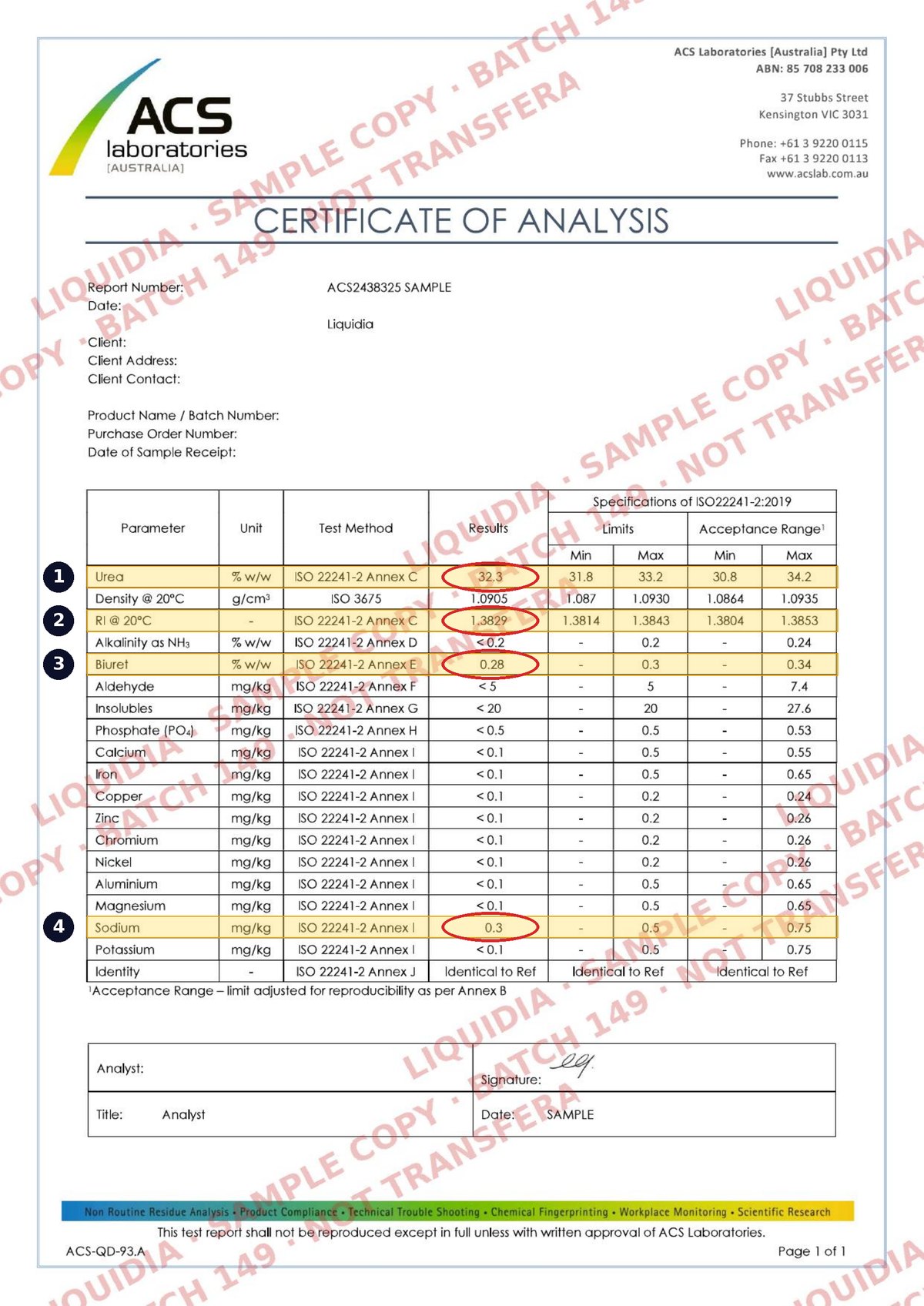
How to read a Certificate of Analysis
Before you send a sample, check the certificate you already have. Our guide shows what to look for.
Check four numbers: urea content, refractive index, biuret and sodium. Sodium is the key contamination check. It comes from dust and impurities and permanently poisons the SCR catalyst.